Pavel Durov, the man who refused to yield
No state, no investors, no compromises. Pavel Durov turned Telegram into a digital fortress and freedom into an engineering protocol.
In a world where freedom erodes through consent, where every click leaves a trace and every platform sells its users, Pavel Durov stands as an anomaly.
Founder of VK (the Russian Facebook) and then Telegram, he gave up everything the system rewards (easy money, fundraising, political recognition) to preserve something that has become rare: total independence.
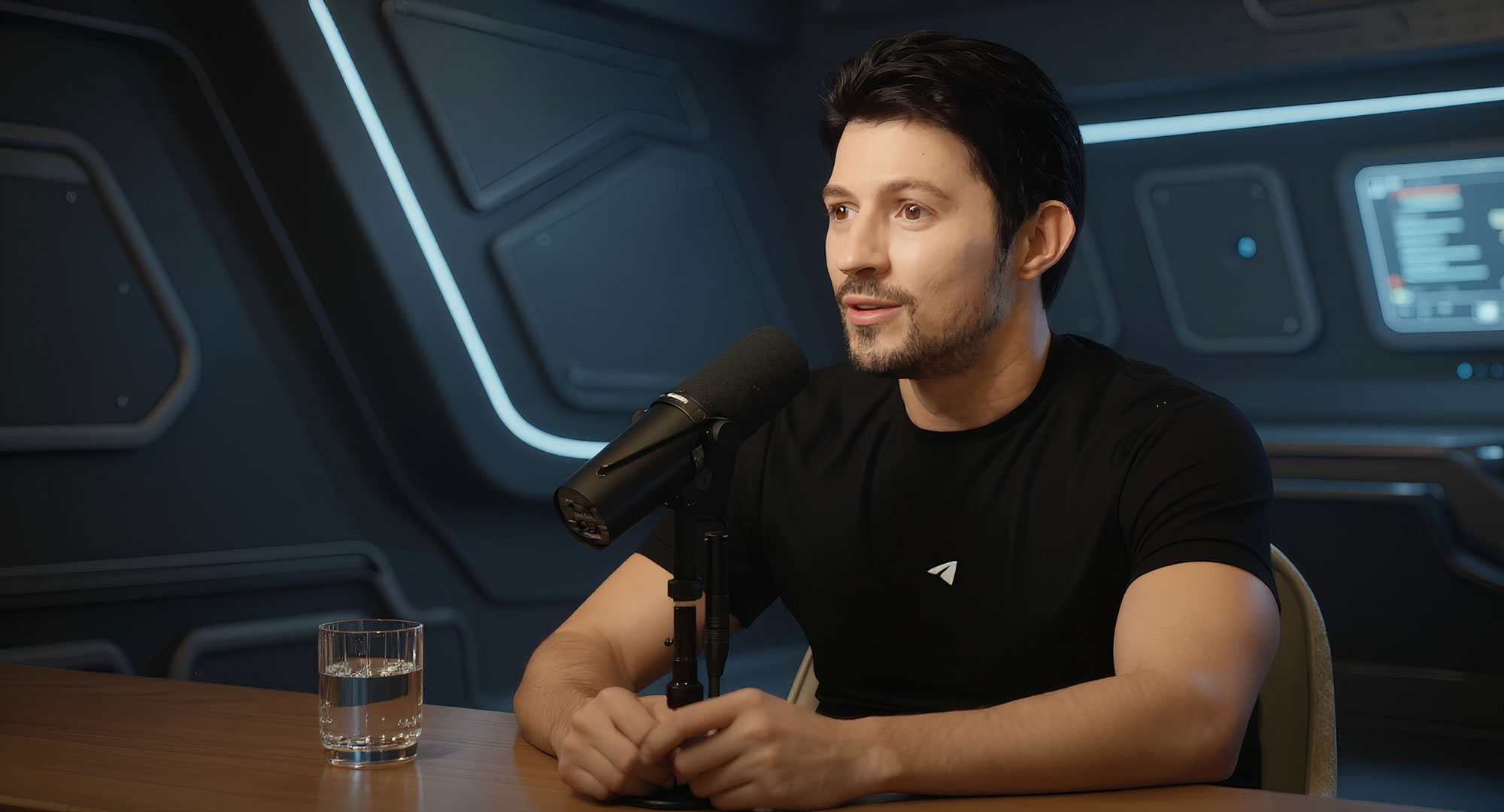
His lengthy interview with Lex Fridman (over four hours) is a deep dive into the inner workings of a free man.
Not in the romantic sense, but in the engineering sense: freedom as a condition for performance, truth, and system integrity.
1. Freedom as an operating system
Durov has never seen freedom as a right. For him, it is an operating protocol.
Born in the USSR, raised in Italy, he experienced two opposing realities: collective control and individual freedom.
"Societies that restrict freedom become inefficient. Energy is wasted on fear."
His approach is radical: any dependency is a weakness.
That is why Telegram has no shareholders, no investors, and no fixed headquarters.
It is a stateless company, a kind of DAO before its time.
This is not about evading rules, but about remaining incompressible.
"The moment you accept money from a state or a fund, you belong to them."
Telegram is not a product.
It is an architecture of resistance.
An infrastructure designed to function even if everything else collapses.
2. Discipline and asceticism: freedom comes at a price
Durov lives without alcohol, without a personal phone, without material attachment.
He trains every day, eats little, sleeps little.
"You cannot control the world, but you can control yourself."
This is not stoicism for show. It is a strategy.
Every dependency is an entry point for manipulation -- through dopamine, advertising, or laziness.
Telegram, in its design, reflects this same logic: no unnecessary distractions, no bloated code, no marketing gimmicks.
His asceticism is not a spiritual posture, but a discipline of power.
In a world saturated with notifications, the true scarcity is focus.
And this may be the key: Durov is not trying to escape power -- he is trying to master it from within, through discipline.
3. Telegram: a geopolitical anomaly
900 million users. Zero investors. Zero advertising. Zero debt.
Telegram belongs to no state, is financed by no bank, and answers to no government.
"We would rather shut down Telegram in a country than violate a user's privacy."
This is a quiet declaration of war against the very structure of modern power -- that of platforms, regulators, and states.
When in 2024, France had Durov arrested amid investigations linked to disinformation, it was a signal: Telegram is a problem.
The platform is not merely a communication tool.
It is a digital free zone, a space that escapes institutional control.
In a world where everything tends toward centralization -- (GAFAM, CBDCs, generative AI, mass surveillance) -- Telegram moves in the opposite direction: fragment, encrypt, distribute.
Its very existence challenges the established order: what if individual sovereignty became possible again on a planetary scale?
4. Power, corruption, and human nature
For Durov, censorship is not an ideological question. It is a biological reflex.
Every organization tends toward self-preservation. Governments, media, platforms: all end up extending their power in the name of the "common good."
"No dictator starts by saying: I want to make you unhappy. They say: I want to protect you."
The mistake, he says, is believing that evil comes from a few corrupt individuals.
The real danger is the natural mechanics of control -- that gradual slide where every rule seems reasonable, every ban temporary, every form of surveillance "necessary."
Telegram is not a libertarian utopia.
It is a firewall against this natural slope.
By refusing pressure from Russia, Iran, France, or Apple, Durov is not defending an ideology, but a physics: that of minimal resistance to the corruption of the system.
5. The economics of resistance
Telegram reached profitability with more than 15 million Premium subscribers, without selling data, without advertising, without debt.
It is an industrial feat.
And an economic manifesto: you can create value without betraying trust.
"Money should never be the driving force. It is fuel, not a GPS."
Durov has turned down buyout offers worth several billion.
He prefers sovereignty to wealth.
His only asset: Bitcoin.
Not for speculation, but to stay liquid, mobile, unassailable.
He speaks of the "two-chair dilemma":
On the first, comfort, money, acceptance.
On the second, freedom, solitude, risk.
"Anyone who tries to sit between the two ends up falling."
In a world where everyone seeks to be "safe," Durov chooses the chair of fire.
6. Beyond the body: continuity and immortality
Toward the end of the interview, the conversation shifts to death, legacy, and consciousness.
Durov speaks little about himself, but often about his brother Nikolai -- (a mathematical genius and co-founder of Telegram) -- and their father, a professor of philology.
This intellectual lineage shapes his vision: knowledge as heritage, freedom as duty.
"We cannot control our mortality, but we can control what we leave behind."
He discusses the concept of quantum immortality: the idea that in an infinite multiverse, there will always be a version of us that continues.
That survival is not biological, but probabilistic.
This idea encapsulates his entire journey: not seeking to live longer, but to create systems that outlive their creators.
Telegram is not a company.
It is a self-sustaining organism, designed to live without a master, without a center, without compromise.
An experiment in sovereignty applied on a global scale.
Conclusion: Freedom as a vital risk
Pavel Durov is not a role model, much less a messiah.
He is a stark reminder that freedom is never given, always taken.
That it is not decreed, but maintained -- through discipline, refusal, and courage.
In a world where conformity is sold as virtue and security as the ultimate horizon, he embodies an uncomfortable truth:
Freedom is not comfortable. It is dangerous, demanding, uncompromising. But it is the only thing worth protecting.
FRACTALS - Mapping the forces reshaping the future.