A paradoxical question
Artificial intelligence fascinates as much as it worries. In the collective imagination, it conjures images of cold machines, faceless algorithms, and jobs replaced by faster, cheaper robots. In short, a technology that could dehumanize us.
But what if this vision were incomplete? What if AI were not a force pulling us away from our humanity, but rather a tool capable of revealing it even more?
Today, it is already our organizations that turn us into mechanical cogs. The pursuit of profitability and productivity pushes us to act like machines: filling out forms, following procedures, checking boxes. We spend our days "doing," without always finding the time to "be."
What if AI could change that? What if, by absorbing these repetitive and time-consuming tasks, it finally gave us the space to focus on what makes us unique: listening, creativity, innovation, empathy, the ability to resolve situations that fall outside the norm? A future where technology does not diminish us, but sets us free.
To understand what is at stake, we can take a detour through an unexpected field: fast food. The rise of fast food transformed our relationship with food by making a ready-to-eat meal accessible, practical, and inexpensive. This model changed our habits, but it did not make gastronomy or Michelin-starred chefs disappear. On the contrary, it stimulated a counter-trend: that of slow food, short supply chains, and culinary experiences that celebrate craftsmanship, creativity, and connection. The more machines advance, the more we seek to highlight what cannot be industrialized.
With artificial intelligence, the same mechanism could occur. ChatGPT and its peers are the intellectual equivalent of fast food: fast, accessible, efficient. But they can also awaken a new demand for the equivalent of slow food for the mind: nourishing knowledge, deep reflection, and intellectual and human experiences rich with meaning.
This is where our specifically human qualities take on their full significance. Empathy, consideration, kindness, self-awareness, and genuine attention to others are not skills that a machine masters today, and perhaps never will with the same depth. Because while AI can simulate emotions or imitate behaviors, it does not live the human experience. And as we interact more and more with automated systems, our need for authenticity, human validation, and sincere relationships will become even more vital.
Curiosity, the engine of innovation and progress, distinguishes us just as much. It is what drives us to ask questions, explore the unknown, and challenge the obvious. AI can assist us, but it cannot fuel this inner fire. On the contrary, by freeing us from repetitive tasks, it gives us the time and energy to rekindle this engine of discovery.
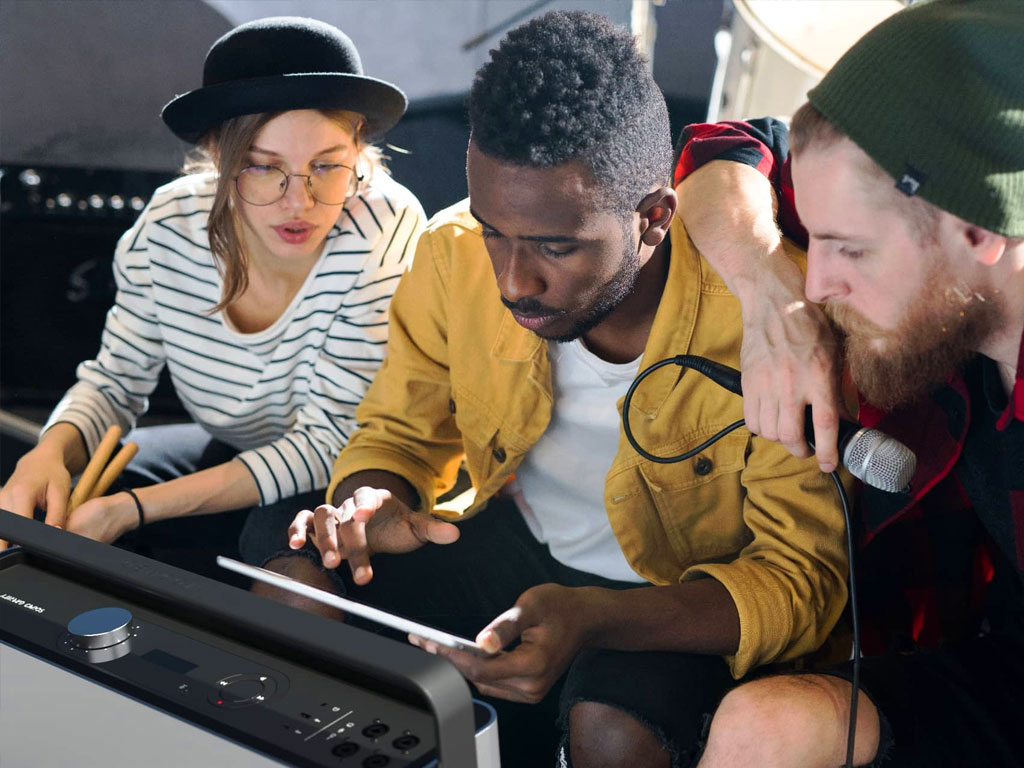
We can already see this in many sectors. In music, AI can generate arrangements or optimize a mix. But emotion and intention remain profoundly human: only the artist knows why they choose a particular silence or rhythm. In healthcare, AI automates the administrative side, but it is the touch of an attentive nurse or a listening doctor that makes the difference in care. In business, AI sorts and classifies, but it is managers who instill vision and cohesion.
In other words: AI is not here to replace humans, but to create the space that allows us to better embody our humanity. It should not be seen as a force that diminishes our professions, but as an opportunity to restore their meaning, by refocusing individuals on what gives them unique value: relationships, creativity, innovation, and empathy.
AI as a mirror of our values
Artificial intelligence has no will of its own. It has no desire, no morality, no intention. It is a mirror: it reflects what we project onto it, it amplifies what we value.
Therein lies its full ambivalence. If we entrust it only with our current obsessions (productivity, control, profitability), it will merely extend our flaws. It can become a machine for surveillance, sorting, and exclusion. In dealings with government services or administrations, this would produce a world of cold algorithms, mechanically applying rules without nuance. In companies, it could reinforce the logic of numbers over meaning. And in the geopolitical sphere, AI could be co-opted to perfect the art of war, accelerating conflicts fueled by ego, fear, or frustration -- those very human impulses that our societies have never fully managed to transcend.
But the mirror can also reflect something else. AI could become a tool for personalization, adaptation, and attention to individual uniqueness. It can help better understand each person's needs, streamline exchanges, and free up time for genuine connection. It can be put in the service of cooperation rather than competition, of care rather than domination. In that case, far from dehumanizing us, it would amplify our humanity.

In reality, AI will not choose. It will be neither inherently good nor bad. It will be what we decide to make of it. A reflection of our shadows if we let our most primitive instincts guide it; a reflection of our ideals if we choose to inscribe our highest values into it.
If AI is a mirror, let us look at it head-on. What does it concretely change in our lives and professions?
When AI frees up time to be human
9:17 AM. You call your service provider. Usually, it is a merry-go-round of transfers. This time, the AI recognizes your file, corrects the billing error in thirty seconds, then directs you to an advisor: your case falls outside the standard framework. She listens. She investigates. She resolves it. Ten minutes later, it is sorted. What changed? Not you. Not your problem. The mechanics were handled upstream. What remains is human time.
"AI absorbs the ordinary; the extraordinary becomes human again."

This quiet shift can already be seen in meetings: systems take notes, summarize, and track action items; teams, freed from live minute-taking, focus on exchange, debate, and decision-making. The "mechanical doing" fades in favor of "doing together."
The same logic applies to customer service: in the current model, if your problem does not fit the boxes, you hit a dead end. As soon as AI handles standard requests (refunds, subscriptions, invoices), advisors become available again for the exceptions. Their role changes: fewer scripts, more listening and ingenuity to resolve the atypical.
In local justice, thousands of small disputes overload the courts. When AI filters simple cases, provides guidance, and drafts summaries, it frees up time for what demands nuance: understanding emotions, arbitrating with humanity, rebuilding connections rather than simply punishing.
In insurance, filing a claim often feels like a double punishment: after the shock comes the paperwork. Entrusting algorithms with the indemnification of routine cases allows advisors to focus on the most serious situations: fires, accidents, bereavements. There, what matters most is not speed, but being present.
And for administrative procedures, everyone knows the irony of the message "Your file is incomplete." As soon as AI processes standard forms end-to-end, agents can return to their true calling: welcoming, helping, and supporting the elderly, newcomers, and all those whose lives do not fit the logic of a form.
This movement spans other sectors. In healthcare, relieving caregivers of administrative burdens frees attention for the patient. In education, grading and adapting exercises can be automated; sparking curiosity cannot. In transportation, route optimization gives agents the time to inform, reassure, and assist. Everywhere, the same thread: when AI handles the ordinary, humans reclaim the extraordinary.
This does not mean everything will go smoothly. A poorly designed AI can, on the contrary, lock people further into rigid processes. But if we think of it as a tool of liberation, it will become that invisible filter that removes the noise so we can hear the music again.
In a world saturated with forms, protocols, and scripts, we have ended up behaving like machines. AI might just be the paradox that forces us to become human again.
What if, from now on, performance were measured not by tasks completed, but by human qualities?
Redefining what truly has value
The automation of mechanical tasks and raw intellectual work is triggering a silent but radical shift: performance criteria are changing. Until recently, an individual's effectiveness was measured by the ability to produce quickly, execute flawlessly, and accumulate tangible results. Those who climbed to the top were not always the most creative or empathetic, but often those who knew how to impose their power, play the game of power dynamics, and exploit the system's weaknesses.
Tomorrow, these skills will become commonplace, absorbed by machines. Spreadsheets, profitability calculations, optimized procedures -- all of this will be handled better and faster by algorithms. Reaching the top will no longer be won through domination or manipulation, but through the ability to inspire, connect, and create human value where machines cannot intervene.
This reversal is not a simple adjustment -- it is a paradigm shift. Added value will no longer reside in execution, but in relationships and inspiration. In the ability to bring forth new ideas, activate collective intelligence, and transform a group into a community.
This shift could also redefine what it means to be a "leader." For decades, we have valued those who decide quickly, impose their will, and excel in power dynamics. But if execution is entrusted to machines, then human power will no longer lie in giving orders, but in building connections. Tomorrow's leaders may not be the most aggressive, but the most empathetic: those who know how to listen, welcome difference, and bring talents into harmony.
"Reaching the top will no longer be won through domination, but through the ability to connect."

This is perhaps the greatest contribution of artificial intelligence: by relieving us of the weight of the quantifiable, it forces us to rehabilitate the unquantifiable. Everything that cannot be measured in checked boxes or spreadsheet columns: trust, emotion, the ability to turn an encounter into something alive.
Tomorrow's human performance will therefore not be a race against machines. It will be the ability to cultivate what machines cannot imitate. Not raw efficiency, but human depth.
A future that is inevitable, and that can reconcile growth and humanity
AI does not force us to choose between efficiency and empathy: it opens the path to their convergence.
Contrary to popular belief, this is not an either/or: more productivity or more humanity. Massive automation will impose itself naturally, because repetitive tasks and raw calculations no longer require human intervention. This means that work as we know it can no longer remain at the center of our economic models.
In this new context, the true capital will be the human: their creativity, their empathy, their ability to connect and inspire. And paradoxically, this evolution will not slow growth. Quite the opposite: AI will enable an unprecedented level of efficiency, while freeing individuals for what gives life meaning.
By freeing humans from the burden of mechanical tasks as well as raw intellectual ones, AI is not just transforming how we work: it is redefining what truly matters. Because if execution can be entrusted to machines, then real value no longer lies in what we produce, but in what we pass on: empathy, creativity, the ability to inspire and connect.
This is perhaps the most fertile paradox of artificial intelligence: by surpassing us in efficiency, it forces us to become fully human again. With it, we will no longer have to choose between doing and being: the two will go hand in hand, in a society where economic performance and human fulfillment finally align.