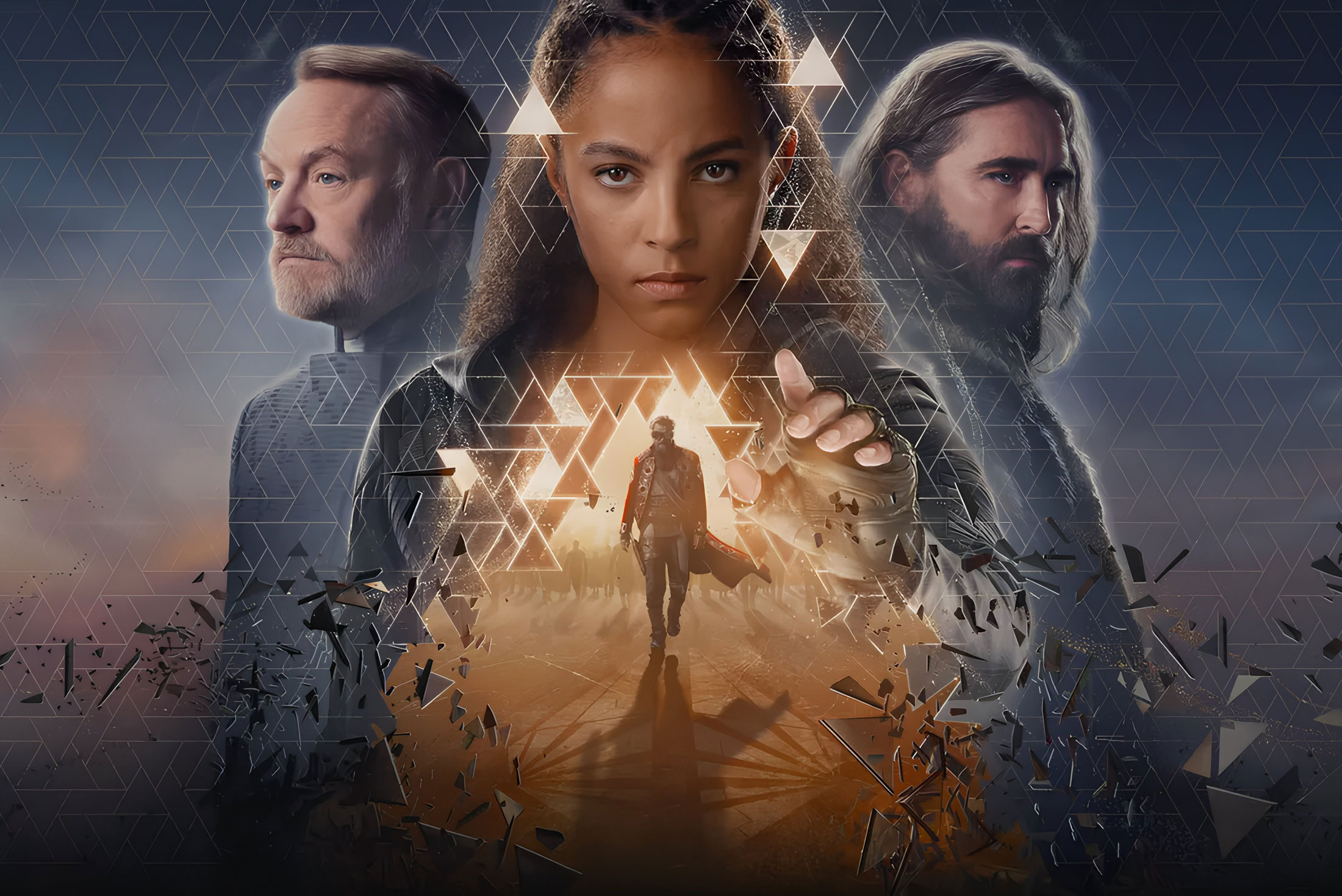
What if our societies were predictable? In Foundation, Isaac Asimov's cult novel adapted into a series by Apple TV+, a scientist imagines a science capable of predicting the collective future. Hari Seldon calls it psychohistory: a kind of weather forecast for civilizations.
Asimov himself explained that his psychohistory was inspired by the gas laws in physics: each molecule is unpredictable, but billions of molecules obey statistical laws. Individuals escape calculation, but masses become predictable.
Brilliant fiction... but it raises a question: in our real world, where pandemics, wars, and AI constantly reshuffle the deck, could we really invent a compass for the future?
When fiction inspires science
In Asimov's work, the formula works thanks to three conditions:

- Large populations: individual behaviors cancel each other out, and the average becomes predictable.
- Stable rules: no sudden upheaval of institutions or technologies.
- Little mirror effect: ideally, people don't change their behavior because they know the prediction.
In the novels, only a small circle knows the "Seldon Plan." In the TV series, on the contrary, everyone tries to follow or thwart this plan -- a perfect example of reflexivity (the prediction alters the future it was trying to describe).
And in our world? We're not talking about prophecies, but about mass statistics and collective cycles. Researchers know that the more you zoom in to the scale of a single person, or the further you push the time horizon, the greater the uncertainty. But in the short and medium term, certain trends become readable. This is the domain of strategic foresight.
What fiction got (almost) right
Cliodynamics: a barometer of the centuries
Cliodynamics, an emerging discipline, proposes analyzing history as a long-duration barometer. Researcher Peter Turchin combined demographics, inequality, public finances, political tensions... Result: cycles that herald periods of great instability.
As early as 2010, Turchin wrote: "American society is entering a period of turbulence comparable to the Civil War." Ten years later, polarization and the 2020 crisis seemed to prove him right.
Think of it as a barometer: it doesn't say "riot on Tuesday at 5 PM," but rather "stormy weather zone in the coming years."
Seshat: a database that challenges conventional wisdom
The Seshat database compiles, in a standardized way, hundreds of past societies. It allows testing of long-held hypotheses:
"Great moralizing gods enabled the creation of great empires."
Looking at the data, it's actually the opposite: great empires appear first, and the "watchful gods" come afterward -- useful for stabilizing what already exists.
"Military pressure drives societies to organize."
Confirmed: in certain regions, competition and war did indeed accelerate the emergence of more complex states.
In short, we keep the ideas that hold up to the facts and drop those that don't.
Forecasting tournaments and prediction markets
Forecasting tournaments pit volunteers against each other on quantified questions ("Will this law be passed before 12/31?"). The best, nicknamed superforecasters, often outperform experts.
During COVID, some anticipated the evolution of epidemic waves faster than health agencies. On the war in Ukraine, these tournaments helped estimate the probability of escalation.
A close cousin, prediction markets (e.g., Polymarket), where a contract's price reflects a collective probability in real time. During American elections, they have sometimes proven more accurate than traditional polls.
These approaches show that a collective signal can emerge. But as soon as the forecast is known, it influences behavior. This is reflexivity -- the prediction sometimes alters the very future it was only trying to describe.
Interlude: what kind of "time" are we talking about?
Before talking about foresight, we need to pause on a seemingly simple question: what is time? Because depending on how we conceive of it, prediction doesn't carry the same weight.
Since Einstein, we've known that time is not a universal clock ticking the same way everywhere: it depends on the observer's speed and gravity. By analogy, one could say that societies also don't all evolve at the same pace: some advance very quickly, others seem frozen in another age.
And yet, we all experience a common direction: time moves forward. This is what physicists call the arrow of time, dictated by entropy. A broken glass doesn't reassemble itself. A revolution or a pandemic leaves a lasting, irreversible trace. History, like nature, carries the memory of what has occurred.
One final dizzying question remains: is time a single line we all share, or a tree that branches at every fork? In the first view, it would be possible to identify a global trend that concerns us all. In the second, each choice opens a new branch, and the future looks less like a road than a cone of possibilities.
In summary, time is relative, irreversible, and open. And it is from this reality that we must think about social forecasting.
Why (and where) it breaks down
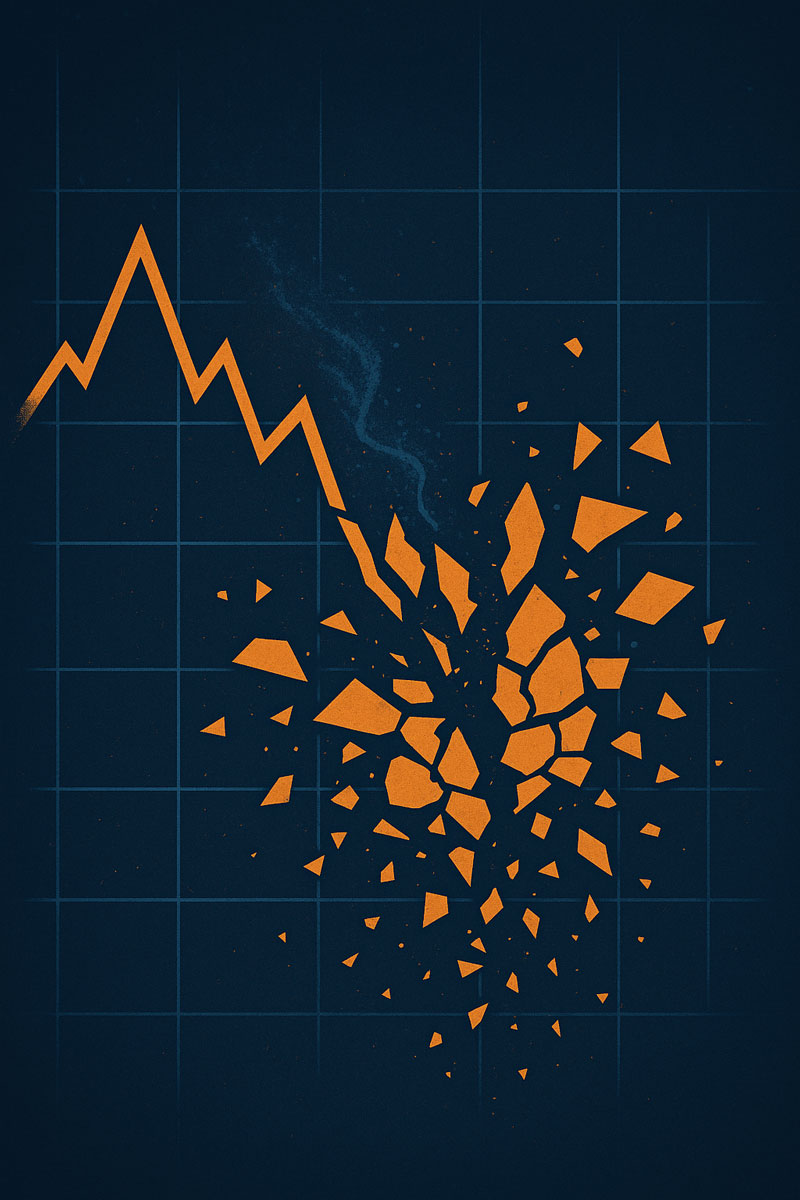
If "modern psychohistory" already exists to some extent, why don't we have a Seldon Plan yet? Because every time we push too far, the models break.
When the horizon stretches, chaos arrives
In the short term, some models work well. But as soon as you extend the horizon, the butterfly effect kicks in and errors accumulate. The internet, social media, the pandemic, now generative AI: in an instant, everything changes, and yesterday's models become obsolete.
When the prediction changes reality
An announcement of a "probable crisis" can trigger panic... and cause the crisis. Conversely, a reassuring announcement can calm markets and cancel the predicted crisis. This is reflexivity, once again.
When the measure becomes the goal
The temptation to turn measurements into objectives is Goodhart's Law. An average grade can serve as an indicator of academic level. But as soon as it becomes a criterion for evaluating teachers, the temptation is great to artificially inflate grades. The indicator no longer measures anything real.
Then there's the Lucas Critique (investors will relate to this one) -- a known rule becomes an exploited rule. If everyone knows the central bank will lower rates in a crisis, investors take greater risks. The initial model is invalidated by the very behaviors it triggered.
But the most formidable limitation remains the data. It is the lifeblood... and the Achilles' heel of foresight.
Data is often incomplete (full of gaps), biased (some groups more visible than others), indirect (we measure "proxies" like tweets, not real opinion), and sometimes deliberately skewed... political and ideological narratives muddy the waters.
Behind a war "for democracy" or a "humanitarian" intervention, there may be a pipeline, a sphere of influence, or a carefully hidden economic interest. Result: the databases we use are already distorted upstream by the official version of events.
In short, "Garbage in, garbage out": if the data is bad or biased, so is the prediction. And in the social and political domain, data is rarely truly neutral. History is written by the victors... and so are their data models...
Conclusion: not a prophecy, but a compass
Asimov gave us a splendid myth: a scientist who reads the future of peoples as one reads the stars. In reality, we don't have a "Seldon Plan" -- and that's a good thing. What we do have is a new alliance: AI as an instrument, strategic foresight as a method.
AI alone is not a prophetess. It is a spotlight, a patient calculator, capable of sorting through massive data and mapping conditional futures. But without method, its projections quickly turn into sterile curves or the illusion of an oracle.
As futurist Hugues de Jouvenel summarizes: "Forecasting is not guessing, it is illuminating choices."
Together, these two dimensions complement each other:
- AI illuminates the paths (data, signals, probabilities),
- method guides the gaze and the decision (scenarios, governance, action).
Our future is not written -- it is sculpted by our choices. The challenge is not to predict a single future, but to prepare for multiple futures and choose the one we want to make more likely.
AI is far from replacing your intuition. But used well, it gives it shoulders (data), a compass (scenarios), and a flight log. It's up to us to pilot.